
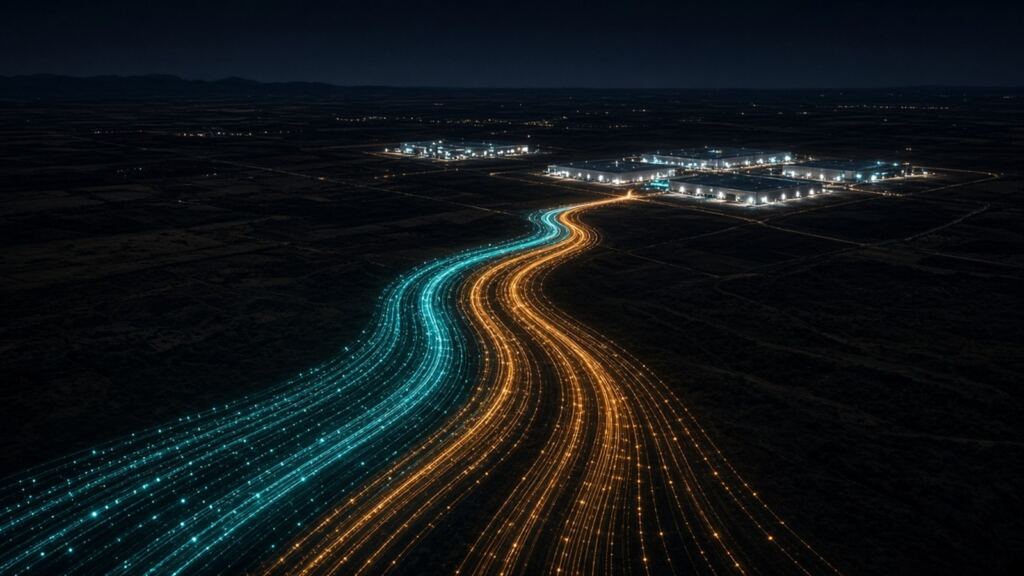
Until a few years ago, America’s main fiber routes were drawn around big cities and the old data-center hubs. The map is moving. AI data centers go where power and land are cheaper — often outside those legacy hubs. That means new corridors and fiber capacity that did not exist before.
Zayo, one of the largest network-infrastructure providers in North America, is working with Nvidia to build more than 8,000 miles of new long-haul fiber on those emerging corridors. The company’s wider plan is 15,000 miles of new route by 2030. Six brand-new paths and capacity upgrades in 10 high-demand markets sit at the core of the project.
The numbers that show the strain
Zayo’s bandwidth report is blunt: long-haul dark-fiber demand doubled in a year. New fiber sales tripled. In some AI-heavy metro hubs — New York, Chicago, Dallas — metro fiber demand is up as much as 20 times. Orders that used to be 8 or 12 fibers now reach 432. Capacity that was meant to last a decade is being absorbed in 12 to 18 months.
Nvidia is the anchor customer on the new routes and has reserved a large share of capacity. Zayo still owns and operates the network and will sell what is left to other customers. Routes in the plan include Denver to Chicago, Dallas to Austin, Atlanta to Ashburn, and Las Vegas to Reno.
The race to lock in fiber supply
The pressure is not only on Zayo. Amazon signed a multi-billion-dollar deal with Corning for fiber and interconnect gear for its data centers, including about 1,000 new jobs at plants in North Carolina. AT&T closed a more-than-$3 billion agreement with Corning in late September 2026 to supply fiber and cable for a build-out to 60 million locations by 2030. Verizon has a similar multi-billion-dollar pact for more than 80 million miles of fiber through 2032.
Corning has become a strategic bottleneck. Fiber makers are adding plants to serve hyperscalers, neoclouds, and telecom operators at the same time, and the strain is still high.
Why this is more than “more cable”
Hyperscale network design is changing. When GPU clusters of hundreds of thousands of units sit in scattered sites, the links between them matter as much as the compute. Without high-capacity, low-latency fiber, those clusters are expensive refrigerators. Zayo and Nvidia are aiming at that point: build the plant before demand snaps.
Energy and land limits are also pushing data centers away from traditional cores. That geographic spread makes new long-haul routes more urgent. Teams that reserve capacity and pour route first will hold a real edge. Everyone else may wait years for a connection.
Physical AI infrastructure is no longer only power and chips. Fiber, route, and network capacity now decide who can actually run at scale. The U.S. map is being redrawn, and the people who took that seriously are already laying cable.